It has been more than a quarter of a century since the world lost Selena Quintanilla, the Queen of Tejano music, to a senseless act of violence, but the woman convicted of her murder has not stopped speaking about her from behind prison walls. Yolanda Saldívar, serving a life sentence for the 1995 shooting, continues to write letters, file legal statements, and make claims that many describe as disturbing, obsessive, and devoid of true remorse. Those who have read her words or heard what she is still saying agree on one unsettling truth: while Selena’s legacy inspires joy and music, Yolanda’s writings bring only darkness, a refusal to let go, and a chilling attempt to rewrite history.
 For millions of fans, Selena is not just a singer but a symbol of cultural pride, innocence, and dreams unfulfilled. Her music still plays across generations, her face adorns murals and magazine covers, and her story remains a source of comfort and heartbreak. She was vibrant, kind, and real, never hardened by fame. Her tragic death created a shadow that never fully lifted. When someone like Yolanda disrupts that memory, it does not go unnoticed. Her continued presence in the media feels like a dark echo that refuses to fade, and her efforts to stay in the conversation have left fans asking why she is still talking.
Yolanda Saldívar was sentenced to life in prison for the murder of Selena Quintanilla on March 31, 1995. The case was as public as it was painful. Yolanda had been more than a fan; she was entrusted with running Selena’s fan club and overseeing parts of her business. She was invited into the family fold. But accusations of embezzlement led to tension, a confrontation, and then violence in a motel room in Corpus Christi, Texas. Yolanda pulled a gun and ended the life of the woman she claimed to admire. The court did not buy her story, and the public did not either. She was sent away with a life sentence and the possibility of parole after 30 years.
For many, that should have been the end of Yolanda’s story, but it was not. From the early years of her imprisonment to more recent times, she has continued to speak about Selena, not always through interviews but in statements, parole documents, and reported letters from prison. The disturbing part is that she often paints herself as the victim. In a 2020 interview, she claimed she was misunderstood and that she did not mean to hurt Selena. Fans were not buying it because these were not words of remorse but words of deflection. Over time, it became clear that Yolanda was not just apologizing; she was rewriting history.
She has suggested that the shooting was an accident, that she had been pushed, and that it was all a misunderstanding. In some cases, especially in documents tied to her parole eligibility, she has hinted that Selena bore some of the blame. That is what makes these letters and statements so difficult to read because they do not reflect closure but fixation. Multiple sources over the years have spoken of Yolanda continuing to write about Selena from her cell. Some say she journals obsessively, while others claim she writes letters addressed to journalists or legal teams, often referencing Selena in chilling detail.
In one documented instance, Yolanda claimed to hold secrets that have never been told. Another time, she described Selena’s final moments in a way that felt invasive, as if she were still trying to control the narrative even now. These are not just letters; they are attempts to stay attached. That is what haunts so many fans. While the rest of the world has tried to move forward, to honor Selena’s memory through celebration and music, Yolanda keeps dragging it backward, not with tears but with ink. There is something chilling about a person who speaks in circles, who never admits, never apologizes, and never lets go.
In a 2020 parole-related filing, Yolanda reportedly included statements attempting to justify her actions. She did not call it murder but a tragedy, an accident, a moment of emotional confusion. She said she loved Selena and would never have intentionally hurt her. But then she blamed Selena’s father, Abraham Quintanilla, suggesting that pressure from him had pushed things too far. She claimed that Selena was torn between loyalty to her family and loyalty to Yolanda. In another documented interview from years earlier, she said, “Selena didn’t want to leave me behind. That’s what hurt her the most.” That quote sent chills through fans because it did not sound like accountability but ownership.

It sounded as if Selena belonged to her, as if even in death, Yolanda still saw herself as part of Selena’s life. When you add up the fragments, the letters, the interviews, and the court filings, one thing becomes clear: Yolanda is not just trying to clear her name. She is trying to stay close to Selena through memory, through words, through revision. Several journalists who followed the case have noted this unsettling trend. One described her tone as emotionally flat, while another said her letters read more like journal entries than reflections of remorse. A former legal analyst who reviewed a parole document submitted on Yolanda’s behalf noted that it is almost like she thinks she still has a relationship with Selena.
That is what disturbs fans the most because Selena is not here to speak for herself. She cannot write letters. She cannot respond. Yet the woman who ended her life continues to write as if she is still part of it. To this day, Yolanda reportedly refers to Selena in the present tense. She has never fully admitted guilt in a way that satisfies fans or the Quintanilla family. Every time she speaks from her cell, it feels like she is opening old wounds on purpose. These are not just words on paper; they are reminders that the story is not over, at least not for her.
It is no surprise that Selena’s family wants nothing to do with Yolanda’s words. Abraham Quintanilla, Selena’s father, has spoken openly about the pain that Yolanda continues to cause. In a rare 2021 interview, when asked about Yolanda’s upcoming parole eligibility, he did not hold back. He said, “She’s never shown real remorse. All she does is talk. She keeps making it about her.” For the Quintanilla family, Yolanda’s letters and interviews are not just frustrating but insulting because they do not reflect sorrow but ego. Selena’s mother, Marcella, has largely stayed quiet, but insiders say that every time Yolanda’s name resurfaces in the media, it brings the family back to that terrible day in 1995.
Chris Perez, Selena’s husband, has also maintained distance. He rarely speaks about Yolanda publicly, but fans have noted his subtle responses, especially when her name trends. In one post years ago, Chris simply wrote, “Some people never learn.” It was never confirmed who he meant, but the timing was unmistakable. While the family stays guarded, the fans are not. Online forums, comment sections, and social media platforms are filled with emotional pleas. Fans write that she is doing this for attention, asking why she keeps talking about Selena, and pleading for her to let Selena rest. There is a pattern here: Selena’s fans, many of them women who grew up with her music, feel fiercely protective of her legacy.
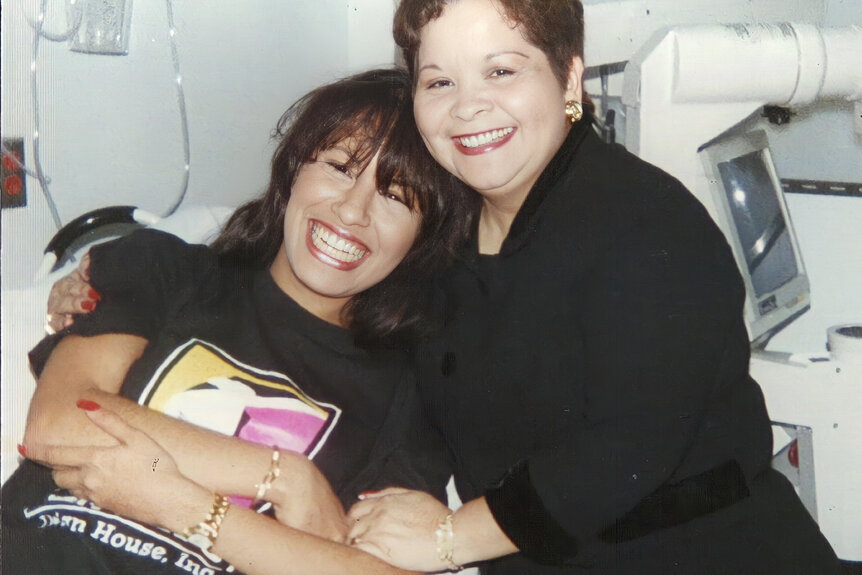
They see these letters and public statements as a violation, not just of justice but of memory. For them, Selena was more than a pop star; she was the one who never got to finish her story. Every time Yolanda picks up a pen, it feels like she is stealing more of it. There is even a growing sentiment among the fan base that media outlets should stop covering Yolanda altogether and stop publishing her letters. One fan wrote that she had her trial and her say, and now she should be silent. Another woman who identified herself as a longtime fan from Texas wrote that Selena was grace and Yolanda is noise, and the more we amplify Yolanda, the more we drown out the beauty that Selena left behind.
The pain in those words is hard to ignore because it is not just about what happened in 1995 but about what keeps happening every time Yolanda sends out another message from behind bars. For months, fans held their breath as 2025 approached. That year marked 30 years since Selena’s death and Yolanda Saldívar’s first chance at parole. The idea that she could walk free after everything sparked outrage across social media and fan communities. The timing could not have been more painful. March 30, 2025, was one day before the anniversary of the day she pulled the trigger. But now the decision is in: her parole has been denied.
While that brought relief to many, it was not a victory because the damage her words have caused did not end with the hearing. In her official filings, Yolanda once again failed to show remorse. She did not call it murder. She did not fully admit guilt. She used phrases like tragic incident and emotional confusion. Instead of accepting responsibility, she pointed fingers at Selena’s father, at the pressures of fame, and even at Selena herself. To those reviewing the case, that was not rehabilitation but evasion. One official close to the parole review was quoted anonymously saying that there was no accountability and no real remorse, and it was clear she still views herself as misunderstood, not guilty.
That is why the letters matter because they were not just private thoughts but proof that Yolanda Saldívar is not just frozen in the past but still trying to rewrite it. That obsession, that refusal to let Selena go, is the very reason her parole was denied. Yet even now, she has not stopped. According to insiders at the Texas Department of Criminal Justice, Yolanda continues to write from prison, sending letters, notes, and statements. In some, she still refers to Selena in the present tense. In others, she drops cryptic hints about untold truths or what really happened. To fans, these are not just words but threats to Selena’s memory and to the peace so many have spent decades trying to protect.

The justice system may have kept Yolanda behind bars, but her voice is still leaking through, and the wounds she caused are still wide open. There is a reason this story still hurts. Selena was not just a rising star. She was not just beautiful or talented. She was beloved. Her death was not just tragic but senseless. For years, her fans have done everything they can to keep her memory alive through tribute concerts, documentaries, foundation work, and heartfelt stories passed from one generation to the next. They do not talk about the tragedy but about the light, the smile, the voice, and the kindness. That is the Selena they remember.
But every time Yolanda speaks, whether through a letter, a filing, or a so-called reflection, it feels like a cloud passing over that light because she does not speak with regret or grace. She speaks with control, still trying to define a moment she created, still trying to justify the unjustifiable, and still trying to stay connected to a life she destroyed. Maybe that is the most disturbing part of all because Selena deserved peace, not just in life but in memory. Decades later, she is still being pulled into the darkness of Yolanda’s words. Fans do not want revenge. They want silence, not because they hate but because they loved her.
They still do. When they say let Selena rest in peace, it is not just a phrase but a plea for the letters to stop, for the media to stop giving Yolanda attention, and for the story to belong to Selena again, not to the woman who ended it. If Selena taught the world anything, it is that grace lasts longer than hate. If Yolanda Saldívar cannot find the silence to honor that, then maybe the rest of us can. For more of the latest news, check out this.
